
PFCC Conference 2026: Warning of drug-driving as growing risk in county
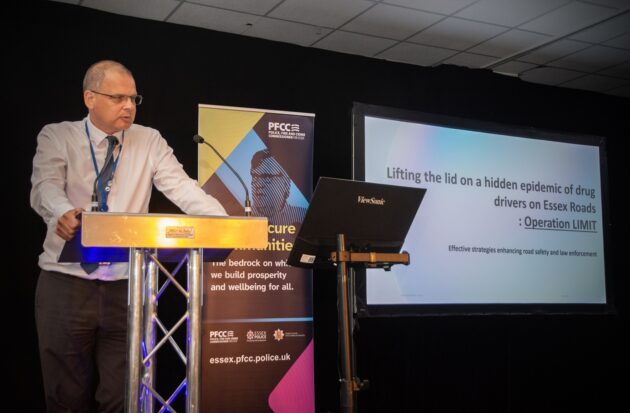
“It’s the only crime where we hand the weapon back to the perpetrator.”
The startling words from Adam Pipe as he warns drug driving is the biggest growing risk he has seen in his 30-year career with Essex Police.
Head of roads policing, Mr Pipe said the crime – declared an epidemic by Chief Constable BJ Harrington – is an emerging risk on the county’s roads.
With a rise from 971 arrests in 2024 to 1,874 in 2025, the force has already made 1,274 arrests for drug driving in the first six months of this year.
But, while the figures speak for themselves, Mr Pipe believes the truth is as many as one in ten drivers are on the road under the influence of cannabis or cocaine, or misused prescription drugs.
Now, the force is leading the way in tackling the crime, successfully seeking permission to handle suspects in a radical new way from this month.
He told the annual conference of the Police, Fire and Crime Commissioner for Essex – entitled The Power of Partnerships: Keeping Essex Safe Together” – “Drug driving is the biggest risk I have seen growing in 30 years.
“The more we look, the less we like what we see, and we are only at the tip of the iceberg.”
In 2017, it was made an offence to drive with more than the – “very low” – legal limit of cannabis or cocaine in the system.
Since then, 9.3 per cent of people killed or seriously injured on Essex roads have had cannabis or cocaine in their system – amounting to more than 90 people.
Of those killed on the road, a third had cannabis or cocaine in their system or within a vehicle involved in the collision.
With many drug drivers found to be reoffenders – 35.4 per cent - Mr Pipe told how policing alone will not solve the problem.
He told how his team of 100 road policing officers are “pushing the boundaries” in Essex, leading the way with tactics and results.
Among the new tactics, every road policing officer has had impairment training, so can spot the tell-tale signs someone is over the legal limit, even if they pass a roadside swab test.
He said: “We cannot police our way out of this issue. We are not going to make the difference on our own. We cannot do this without the wider public being aware of this problem. It is a real issue.
“We are back to where we were in the 60s and 70s when drink driving was deemed to be acceptable.
“But, as of today, we have pushed the boundary with how we handle people arrested for drug driving. Now, if someone is arrested for multiple offences, has caused serious injury or a fatality, we have made arrangements with our blood tester to expedite their bloods to get us a result within a maximum of six weeks. Our custody officers can also now bail them with the condition they cannot drive while we wait for the results. We will also now alert their car insurance company. It is not right if you are brought into custody for these crimes that you are given the keys to your car back. It’s the only crime where we hand the weapon back to the perpetrator.
“That will amount to about 28 people per month taken off the roads while we await their blood results. It is the only way we think we can reduce the risk.
“My team’s focus will not stop. We are very much at the forefront nationally of what is going on and to get legalisation changed.”
The force carries out two drug driving operations on the roads each month, stepping that up even further during events such as the World Cup, with six operations planned during the football tournament.
FACT FILE
- Average age of drug drivers in Essex – 34
- 40 per cent of drug driving suspects have links to domestic abuse or violence against women and girls
- 65 per cent of the arrests made so far in 2026 have been people aged 25 to 44
- 70 per cent of drug drivers arrested in the county are from Essex
- 58.8 per cent of drug drivers have convictions for high harm crimes, such as violent crime, ABH and common assault